Quick answer
First, check whether you should convert at all — many universities want your grades on the original scale and convert them themselves, or ask for an official evaluation from a service like WES. If you need an estimate, don't just divide your mark by the maximum: in the UK a 70% is a First (about 3.7–4.0), not 2.8. For Germany, use the official modified Bavarian formula: German grade = 1 + 3 × (best − yours) ÷ (best − pass). The free converter below does both for 10 grading systems.
About 7.3 million students now study outside their home country, according to UNESCO — and millions more apply to exchange programmes, scholarships and graduate schools abroad. Almost all of them hit the same wall: the form asks for a "GPA on a 4.0 scale", and your transcript says 15.4/20, 1.7, 68% or 8.2 CGPA. This guide is for students everywhere — from Lagos to Lyon, Manila to Melbourne — and explains how conversion really works, so you report your grades accurately and confidently.
Should you convert your grades at all?
Often, no. Before you calculate anything, read the admissions or scholarship page carefully. You will usually see one of three instructions:
- "Report grades as they appear on your transcript." The most common rule for international applicants. Enter your original grade and scale (for example 15.2 / 20) and let the university convert it with its own tables.
- "Submit an official credential evaluation." Common for US graduate schools and some employers and licensing bodies. Services such as WES (World Education Services) or ECE convert course by course and send an official report — your own estimate doesn't count.
- "Enter your GPA on a 4.0 scale." Only here do you need to convert yourself — and you should still say it's an estimate and attach the original transcript.
Why it matters: admissions officers see transcripts from dozens of countries every week. A self-converted GPA that looks inflated (a UK 2:2 reported as 3.8, say) damages your credibility far more than an honest original grade ever would.
Why simple division gives the wrong answer
The tempting shortcut is your mark ÷ maximum × 4. It works badly because every grading system has its own culture of marking:
- United Kingdom: marks above 80% are rare in most subjects. A 70% is already a First Class — the top degree classification. Division would turn it into 2.8, which is wrong.
- France: a common saying is that 20/20 is "for God" and 19 "for the professor". A 16/20 is excellent; division would make it 3.2.
- Germany: the scale runs the other way — 1.0 is the best grade and 4.0 the lowest pass.
- United States: grades are often higher on average, so 90%+ is a normal A range.
That's why credential evaluators use bands — "a UK 60–69 equals roughly a B+/A−" — instead of formulas. The pass mark matters too: in the UK it's usually 40%, in Spain 5/10, in the Netherlands 5.5/10, in Italy 18/30.
Free grade converter (10 grading systems)
International grade converter
Your grade → typical US 4.0 range and German grade. Nothing is stored.
The US ranges are typical equivalents drawn from commonly published conversion tables — individual universities and evaluators use their own, so treat them as a guide. The German grade uses the exact formula German universities apply.
Country-by-country conversion tables
These are the bands most students and advisers work from. Where a range is shown (3.3–3.7), a mark near the top of the band usually sits near the top of the range.
United Kingdom (also used in many Commonwealth universities)
| Degree class | Typical mark | Approx. US GPA |
|---|---|---|
| First Class (1st) | 70%+ | 3.7–4.0 |
| Upper Second (2:1) | 60–69% | 3.3–3.7 |
| Lower Second (2:2) | 50–59% | 2.7–3.0 |
| Third (3rd) | 40–49% | 2.0–2.3 |
Continental Europe
| Country & scale | Excellent | Good | Pass |
|---|---|---|---|
| Germany (1.0 best, 4.0 pass) | 1.0–1.5 ≈ 3.5–4.0 | 1.6–2.5 ≈ 2.5–3.4 | 2.6–4.0 ≈ 1.0–2.4 |
| France (/20, pass 10) | 16+ ≈ 4.0 | 12–15.9 ≈ 3.3–4.0 | 10–11.9 ≈ 2.3–3.0 |
| Netherlands (/10, pass 5.5) | 8+ ≈ 3.7–4.0 | 6–7.9 ≈ 2.7–3.7 | 5.5–5.9 ≈ 2.0–2.3 |
| Spain (/10, pass 5) | 9–10 ≈ 4.0 | 7–8.9 ≈ 3.0–3.7 | 5–6.9 ≈ 2.0–2.7 |
| Italy (/30, pass 18) | 28–30 e lode ≈ 3.7–4.0 | 22–27 ≈ 3.0–3.7 | 18–21 ≈ 2.0–2.7 |
Many European transcripts also show an ECTS grade or a grade distribution table. Under the European Commission's ECTS Users' Guide, these show how your grade compares with other students on the same programme — useful context to include if your transcript has it.
Asia, Africa and Oceania
| System | How to estimate | Example |
|---|---|---|
| 10-point CGPA (India, Pakistan, Nepal, Bangladesh and others) | CGPA ÷ 10 × 4 as a rough guide | 8.0 ≈ 3.2 |
| Percentage (many countries, incl. China) | Depends on the university's band table; check the transcript key | 85% often ≈ 3.3–3.7 |
| Australia (7-point GPA) | HD ≈ 3.7–4.0, D ≈ 3.3–3.7, C ≈ 2.7–3.0, P ≈ 2.0–2.3 | 6.0 ≈ 3.3–3.7 |
| Nigeria / Ghana (5-point CGPA) | First ≈ 3.7–4.0, 2:1 ≈ 3.3–3.7, 2:2 ≈ 2.7–3.0 | 4.0 ≈ 3.3–3.7 |
For the 10-point scale, evaluators like WES look at every course mark rather than the final CGPA, and their result can be higher or lower than the simple formula. Want more detail on 10-point systems? See the CGPA to percentage calculator and SGPA to CGPA calculator.
Converting to the German scale (modified Bavarian formula)
Applying to a university in Germany? Unlike the US, Germany has one official formula. It's set out by the KMK (the Standing Conference of education ministers) and used by universities and uni-assist:
German grade = 1 + 3 × (Nmax − Nd) ÷ (Nmax − Nmin)
Nmax = best possible grade on your scale · Nmin = lowest passing grade · Nd = your grade
Worked example: a UK student with 65% (best 100, pass 40): 1 + 3 × (100 − 65) ÷ (100 − 40) = 1 + 3 × 35 ÷ 60 = 2.75, which most universities cut to 2.7 ("befriedigend"). A US student with a 3.5 GPA (best 4.0, pass 1.0): 1 + 3 × 0.5 ÷ 3 = 1.5 ("sehr gut"). The converter above does this automatically. German universities usually keep only the first decimal, but some round instead, so check their admissions page.
How to report your grades on an application
- Lead with the original. "First Class Honours (72%)", "15.4 / 20", "1.7 (German scale)". This is never wrong.
- Add the estimate only if asked, labelled clearly: "≈ 3.7 / 4.0 (self-estimated; official WES evaluation available on request)".
- Include context. Class rank, top-percentage statements or an ECTS distribution table help reviewers who don't know your system.
- Get an official evaluation when required — and start early, because evaluators need official transcripts sent directly from your university and can take weeks.
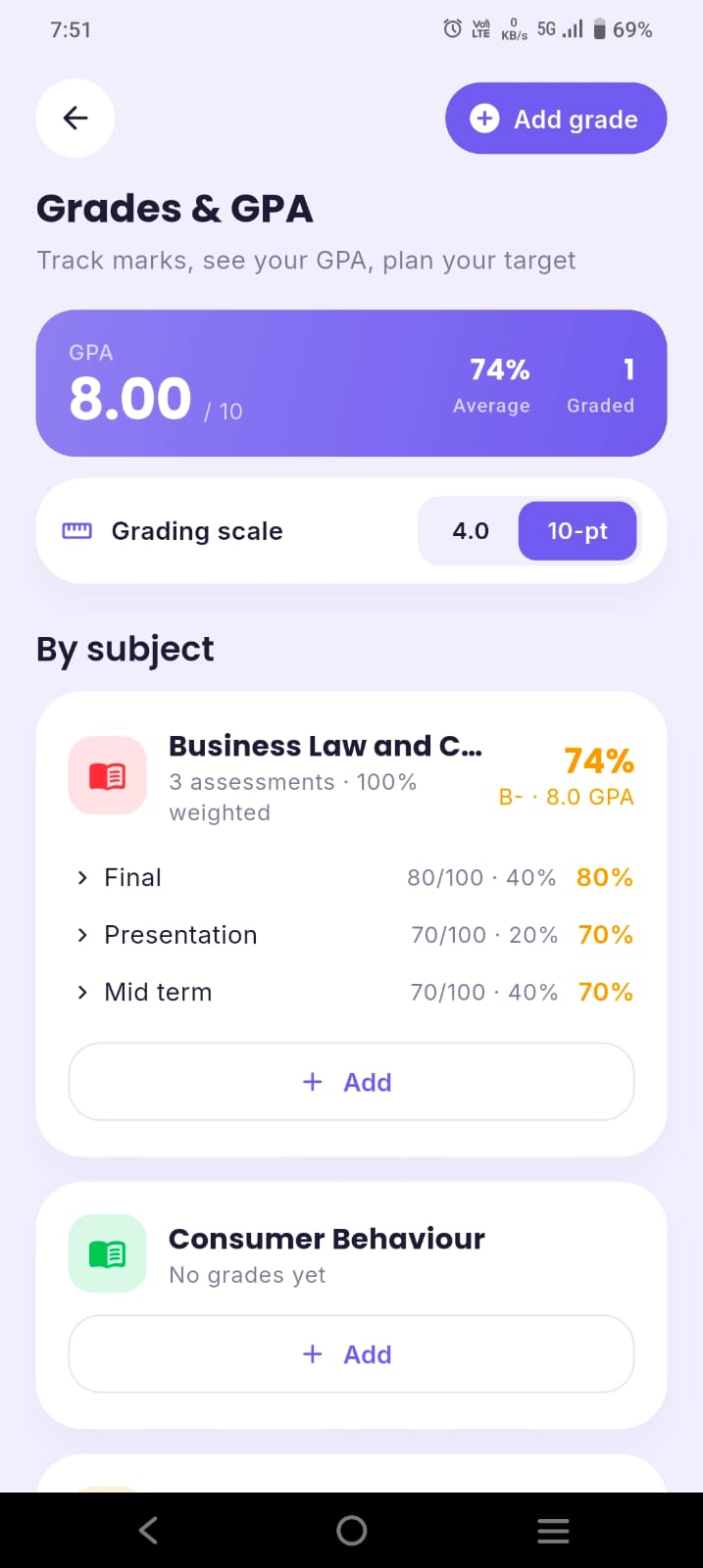
- Keep your own records accurate. Tracking every course grade as you go makes evaluations, scholarship forms and CVs much faster.
Key takeaways
- Check the application first — many universities want original grades or an official evaluation, not your own conversion.
- Don't divide your mark by the maximum: strict systems like the UK and France would come out far too low.
- Typical bands: UK First ≈ 3.7–4.0, 2:1 ≈ 3.3–3.7; French 14+/20 ≈ 3.7–4.0; Dutch 8+ ≈ 3.7–4.0.
- For Germany, use the official Bavarian formula: 1 + 3 × (best − yours) ÷ (best − pass).
- Always show your original grade alongside any estimate.
Track your grades, wherever you study
ClassTrack is a free student app used by students in many countries. Log your marks and your GPA updates on a 4.0 or 10-point scale — next to your timetable, deadlines, exam countdowns and a feed of scholarships matched to your country.
Get ClassTrack freeFrequently asked questions
How do I convert my grades to a 4.0 GPA?
What is a UK 2:1 in GPA?
What is the Bavarian formula?
How do I convert a 10-point CGPA to a 4.0 GPA?
Should I convert my grades myself on an application?
Sources
- UNESCO. Global Convention on the Recognition of Qualifications concerning Higher Education — 7.3 million students studying abroad. unesco.org.
- Kultusministerkonferenz (KMK). Modified Bavarian formula for converting foreign grades; see for example Heidelberg University's explanation and uni-assist admissions guidance.
- World Education Services. iGPA Calculator and country grade conversion guides.
- European Commission (2015). ECTS Users' Guide 2015. Publications Office of the European Union.